
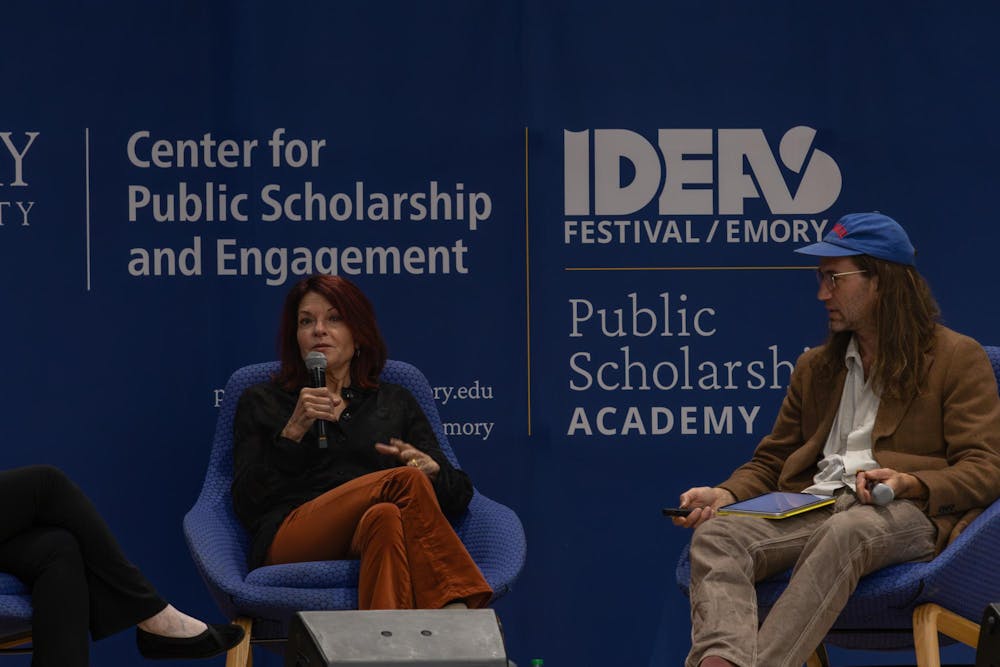
As upbeat music shattered the silent Saturday morning in Oxford, Ga., Emory University students, faculty and parents gathered on Emory’s Oxford campus to celebrate the second annual Ideas Festival, held on Oct. 18.
The Center for Public Scholarship and Engagement, which was launched in the spring of 2024 by Charles Howard Candler Professor of Psychology Kenneth Carter (87Ox, 89C), hosted the festival. The center's mission focuses on “presenting academic research and teaching in accessible ways, while empowering non-experts to navigate the complexities of our global community.” In addition to the Ideas Festival, the center previously hosted the Public Scholarship Academy program, which was designed to help faculty members better communicate scholarly work to the public.
This year’s Ideas Festival spanned the entire day and featured 30 speaker sessions and four stages. Topics of the sessions ranged from historical talks about the 1898 Wilmington Massacre, hosted by filmmaker Brad Lichtenstein and Robert W. Woodruff Professor of African American Studies Carol Anderson, to the significance of museums with author Jessica Handler and former Emory professor and poet Kevin Young. The event also featured a special live taping of Grammy-winning singer-songwriter Rosanne Cash in conversation with Matt Whyte, the host of the “Sing for Science” (2020-) podcast. All attendees could also enjoy an open-air banquet on the Oxford Quadrangle.
Echoing the center’s mission, Carter emphasized the festival’s objective of providing a platform for scholars to share their ideas.
“To me, showcasing the great scholars out there is what today is all about,” Carter said.
Carter also highlighted how the center promotes academic progress by prioritizing public scholarship and discourse.
“The engagement piece of what we do is to really showcase a lot of really excellent public scholars,” Carter said. “And so we do that with the Ideas Festival.”
Students and their families, as well as local community members, attended the festival, which coincided with Oxford College’s Family Weekend. Unlike the inaugural Ideas Festival, which took place in September 2024, Carter said he chose to schedule the 2025 festival during Family Weekend to create more “synergies” of events and attendees on campus. Speaker session topics at the festival ranged from historical
“Those amazing collisions of Emory and community people all here on campus, to me, makes [the Ideas Festival] a magical experience,” Carter said.
Carter also co-hosted one of the festival sessions, “The Science of Horror,” with Senior Director of Culture, Community and Partner Engagement of the Michael C. Carlos Museum and Emory Libraries Clint Fluker (17G). Their session focused on how horror movies channel fears of infectious diseases to create opportunities for terror and intrigue.
Workers’ rights activist Gerardo Reyes Chavez, Nell Hodgson Woodruff School of Nursing Assistant Professor Roxana Chicas (16N, 20G) and Senior Investigative Producer for Al Jazeera Jeremy Young (00C) ran another session, titled “Migrant Worker Health in the Florida Heat.”
The session was centered on the dangers migrant farm workers in Florida face amid rising global temperatures. After the session, Chicas underscored the challenges migrant farmers face while working in the United States and the need for community members to advocate for stronger protections.
“For a workforce that impacts our lives on a daily basis — three times a day, every time we eat — I think that we should do better at protecting them while they are working in the fields,” Chicas said.
During each session, students, faculty and family members were exposed to new and interesting ideas and had the chance to engage directly with the speakers. Emily Medina (26Ox) resonated with Chicas’ session because it made her think more about where everyday products come from.
“We all go to the grocery store,” Medina said, “We all buy our vegetables and our products, right? But we don't sit there and think about these people outside in the sun, from sun up to sundown, picking up all of those vegetables.”
Reflecting on the day’s events, Medina said that while she appreciated the Center for Public Scholarship and Engagement’s efforts to increase the quality and inclusivity of the festival, she only became aware of the events after her professors prompted her to look into the festival. Medina believes the Ideas Festival could benefit from putting more emphasis on its advertising and ensuring easy access to information in the future.
Brushed up and reimagined, the Ideas Festival charted a new path in drawing larger crowds and stirring newfound dialogue on campus, bringing together the Emory community through knowledge and curiosity.


