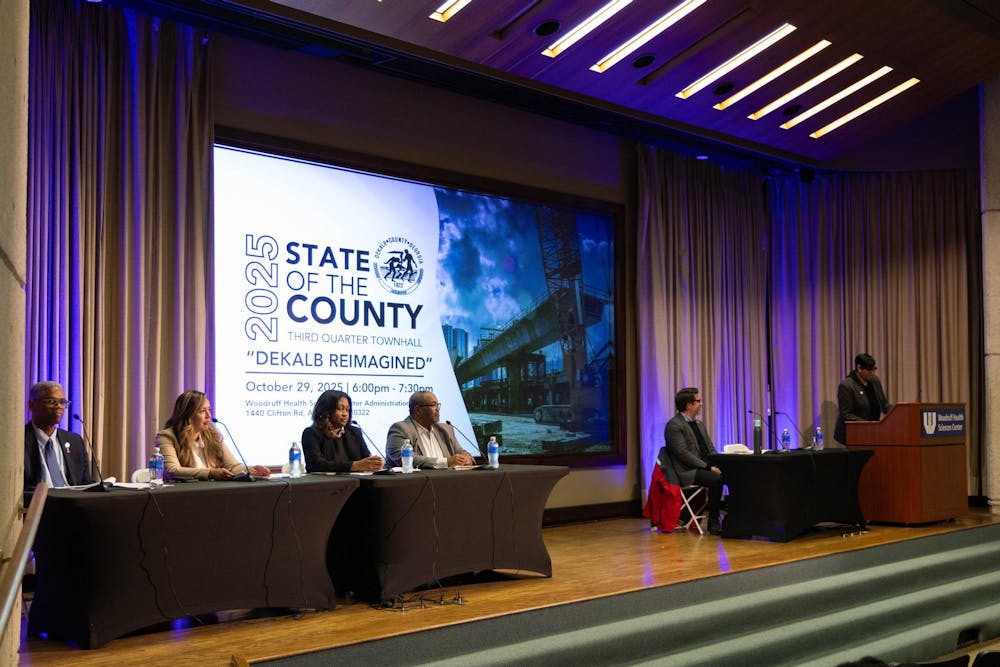
DeKalb County CEO Lorraine Cochran-Johnson hosted the 2025 Third Quarter Town Hall with her Executive Cabinet on Oct. 29 at the Robert W. Woodruff Health Sciences Center Administration Building. Cochran-Johnson and her cabinet addressed countywide initiatives taken during her first eight months in office, focusing on infrastructure, public safety and housing.
As DeKalb County CEO, Cochran-Johnson supervises and directs county administration. She was first elected as DeKalb County Commissioner for DeKalb County Super District 7 in 2018 and was later elected as CEO in June 2024, taking office this January.
Cochran-Johnson began the meeting by outlining current initiatives aimed at improving transportation and infrastructure. These programs include the Buford Highway Arterial Rapid Transit project in collaboration with the Metropolitan Atlanta Rapid Transit Authority (MARTA). This program, currently in progress, will provide more frequent MARTA bus service in high-traffic areas.
“It’s important to talk about along certain corners, particularly Buford Highway, the need for ART,” Cochran-Johnson said. “At this time, we are looking at the current and existing corridors and developing strategies for future transit.”
DeKalb County Chief Development Officer Jacob Vallo, a member of Cochran-Johnson’s cabinet, also highlighted future initiatives to connect DeKalb County with Atlanta, including Atlanta Beltline projects.
“The Atlanta Beltline has agreed to work with us on the connector trail from the Southeast Beltline Trail,” Vallo said.
Vallo emphasized future efforts for “trail-oriented development,” which entails building mixed-income housing, infrastructure and recreation along Beltline trails.
Cochran-Johnson also updated community members on the development of the Snapfinger Advanced Wastewater Treatment Facility Expansion Project. DeKalb County government officials designed the project to address challenges associated with a limited clean water supply. The Scott Candler Water Treatment Plant is currently DeKalb County’s sole source of clean water.
“We have invested over $300 million in Snapfinger, and we are in the final stages,” Cochran-Johnson said. “We are in the testing stages.”
Cochran-Johnson also addressed public safety initiatives throughout the county, highlighting DeKalb County's efforts to increase police officer recruitment and retention.
“You may see state troopers now along Candler Road and in other areas,” Cochran-Johnson said. “We’ve done things that we felt made sense, because we are all DeKalb County residents.”
DeKalb County Chief Housing Officer Alan Ferguson (99B) described issues with housing for DeKalb County residents.
“Understanding our current housing crisis within DeKalb County, according to the last American Community Survey, 40% of DeKalb County residents are cost-burdened, which means they’re spending more than 30% of their gross income on housing costs,” Ferguson said.
Ferguson cited several programs to support the unhoused and underhoused populations in DeKalb County, including an $8 million investment in affordable housing from the county.
“This $8 million in investment is going to secure 60 units of transitional housing, along with wraparound supportive services for this development,” Ferguson said.
DeKalb County Historic Preservation Commission member and realtor Stacey Thibodeaux reflected on the meeting, emphasizing the importance of future initiatives to address the housing crisis.
“Ferguson talked about how the income level of so many of our residents is just not high enough to be able to afford to get into homes,” Thibodeaux said. “The refreshing idea about the programs that the county is putting forth to help home ownership become more affordable.”
Ferguson emphasized the county administration’s willingness to explore various solutions to address the housing crisis.
“We’re not going to be afraid to try different things and to try new measures, to try to make an impact in the housing space,” Ferguson said. “You can look to us as being an innovator in the housing space, and that’s our commitment. We’re dedicated to change, and we’re going to try to make things happen.”