
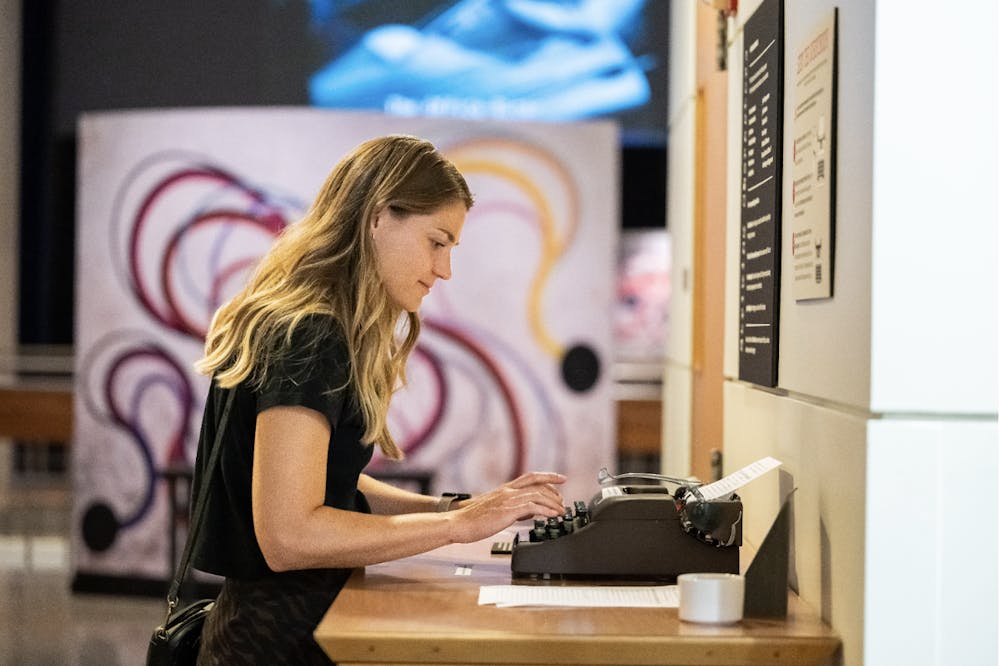
When Tim Youd sits down at a typewriter, he does not craft stories of his own. Youd, a performance artist from Los Angeles, uses typewriters to rewrite other writers’ novels in their entirety.
Thirteen years ago, Youd began his “100 Novels Project,” setting out to retype 100 fiction novels. Word by word, he retypes whole books, but only books whose authors originally wrote on a typewriter. He types each book, in its entirety, on a single sheet of paper, layering hundreds of lines of ink on top of each other.
With a chair, a table and a typewriter, Youd sits and types in the Schatten Gallery in the Robert W. Woodruff Library from Sunday to Friday, 1 p.m. to 5 p.m. By the end of his live typing, which he began on Sept. 19 and plans to conclude on Oct. 17, Youd will type the entirety of Bram Stoker’s “Dracula” (1897) and Noel Langley’s screenplay for the original “Wizard of Oz” (1939).
Youd performs live typing as part of his exhibit in the Woodruff Library, “Striking Characters: Typewriters, Literary Worlds, and the Art of Tim Youd,” which features his art and pieces from the Stuart A. Rose Manuscript, Archives and Rare Book Library.
Youd recently completed the 84th book in his “100 Novels” series. However, he did not always have a clear path toward an art career — despite being exposed to art from a young age.
“My mom was, and still is, an amateur artist,” Youd said. “She had art materials on our high chairs before we could even walk.”
The artist graduated from the College of the Holy Cross (Mass.) in 1989 with an economics degree. After working on Wall Street for two years in New York, he moved to Los Angeles and worked as a movie producer for 10 years. But Youd still felt unfulfilled and turning toward a career in art seemed like the only solution.
“Only after I did all that and got it all out of my system did I then say, ‘You know what? I’m only going to be happy if I make art,’” Youd said.
Youd discovered his interest in retyping by chance. One day, over a decade ago, he read a book and found himself contemplating its physical form. He realized that the book was nothing but a collection of black text rectangles printed on white paper rectangles.
“If I could just get all the text from the whole book to be there on those two pages and I could feel the weight of it and the texture and the distress, then I’d be drawing the book, but not drawing the book in a way that anybody else has done before,” Youd said. “I would be creating this abstraction, but with truly every single word there.”
So Youd decided to try his hand at retyping. He began with journalist Hunter S. Thompson’s “Fear and Loathing in Las Vegas” (1971). Once Youd finished retyping Thompson’s novel on his typewriter, he continued producing new abstractions. He retyped novel after novel, beginning to work in public.
“I didn’t even know [typing] was a performance then, and I didn’t know it was going to be more than one,” Youd said. “It was just an exploration, but I liked it, and I did a few more in my studio.”
Youd designed the “100 Novels Project” somewhat arbitrarily, setting a lofty goal to challenge himself.
“Everybody has 100 ‘best something’ or 100 ‘biggest something,’ and I liked the playfulness of that as well as the devotion,” Youd said. “It was going to take a chunk of time and that shaped it.”
When choosing his next novel for retyping, Youd does not follow a pattern of genres or time periods. But that does not mean he retypes just anything. He will only select novels that he wants to spend time with during the four or five weeks he takes to type a book from front to back.
“I’ve been building this database and anything that I type, or should I say I retype, I’ve read before I do the performance,” Youd said.
At Emory, Youd did not select “Dracula” at random. The Rose Library houses an extensive collection of Stoker’s manuscripts, artworks and vampire-related materials. Alongside his performance and exhibit at Emory, this marks Youd’s first time retyping an archive manuscript.
Hannah Griggs (22G), the subject librarian for English at the Woodruff Library and a co-curator for the “Striking Characters” exhibit, immediately saw the potential to combine Youd’s work and pieces from the Rose Library into a single display.
“As a literary scholar, I loved the idea of an entire novel being on a single sheet of paper,” Griggs said. “ I thought it would be really cool to pair that with a lot of our special collections and some of the really cool things that we have in our archives and see the different ways that they might speak to each other.”
Griggs, alongside Shanna Early (18G), an instruction archivist at the Rose Library and the other co-curator of the exhibit, solidified their interest in Youd’s work after visiting his home studio in Los Angeles.
“I have never had the experience of being in a place and seeing live art and it feeling alive the way that Tim’s work does,” Early said. “That was such a profound experience for me, both in thinking about Tim’s work but also in thinking about art more broadly.”
Aside from live typing, Youd contributed other artwork to the exhibit. He used collaging and painting to create visual pieces, transforming paint chips into renditions of typewriter ribbons and machines to honor the machine’s beauty and power.
“Anything that’s not from the archive is my art,” Youd said. “There are a lot of drawings and sculptures and signs, and they all have to do with the abstraction of the typewriter ribbon and spool.”
Youd believes that typewriters contribute to a more fulfilling writing experience. For example, Charles Howard Candler Professor of English and Creative Writing Tayari Jones uses typewriters to write her books, including her novel “An American Marriage” (2018), which featured in Oprah’s Book Club in 2018.
“It’s a disconnection from the immediacy and the distraction of the internet, which can be poison to a writer,” Youd said.
Youd interprets the physical act of typing on a typewriter as a cerebral endeavor — a practice that connects the words in people’s heads to the physical world in the form of typed letters. He views the brain as a chemical machine and the typewriter as a mechanical conduit for the brain’s creativity.
"The typewriter, in a way, is an external brain mimicking what the brain is doing,” Youd said.
While he types, Youd finds his brain working harder than usual. Working word by word, line by line, Youd both creates art and works toward the goal of close reading he originally pursued through retyping.
Close reading takes time, and retyping takes even more. For his remaining 15 books, Youd estimates he may spend four or five more years retyping them. Looking back on years of retyping, Youd works to unravel the relationship between his life, retyping, fiction and time.
“I started this thing and I was in my mid-40s, and that’s squarely middle-aged,” Youd said. “Unless you have real health problems or something, you’re not necessarily thinking about mortality so much.” In the years since starting his project, Youd developed leukemia—treatable but no less scary.
Now, Youd recognizes the temporary nature of retyping and how his close reading of fiction influences the way he perceives novels and their impact upon his life and the lives of readers.
“I’ve come to appreciate that each time I sit with a book, that might be the last time I read that book,” Youd said. “So it’s a chance for me to come to terms with that book if I can.”
For now, Youd’s work culminates in the “Striking Characters” exhibit — a celebration of how typewriters immortalize stories that become cornerstones of the literary world. Just as Youd sees the power in typewriters, he sees the bittersweet power of fiction itself: “sadness.”
“That’s really what it is,” Youd said. “It’s about the passing of time and the learning of lessons and of loss and reconciliation and acceptance.”

Hunter Buchheit (he/him) (28B) is majoring in U.S. History and Business. He loves writing about music, Emory events and politics, and in his free time enjoys playing piano, running and spending hours crafting the perfect Spotify playlist.


