
Emory University community members gathered in Cannon Chapel on Sept. 25 to hear Katherine Stewart, an investigative journalist and author, discuss the growing influence of Christian nationalism in the U.S.
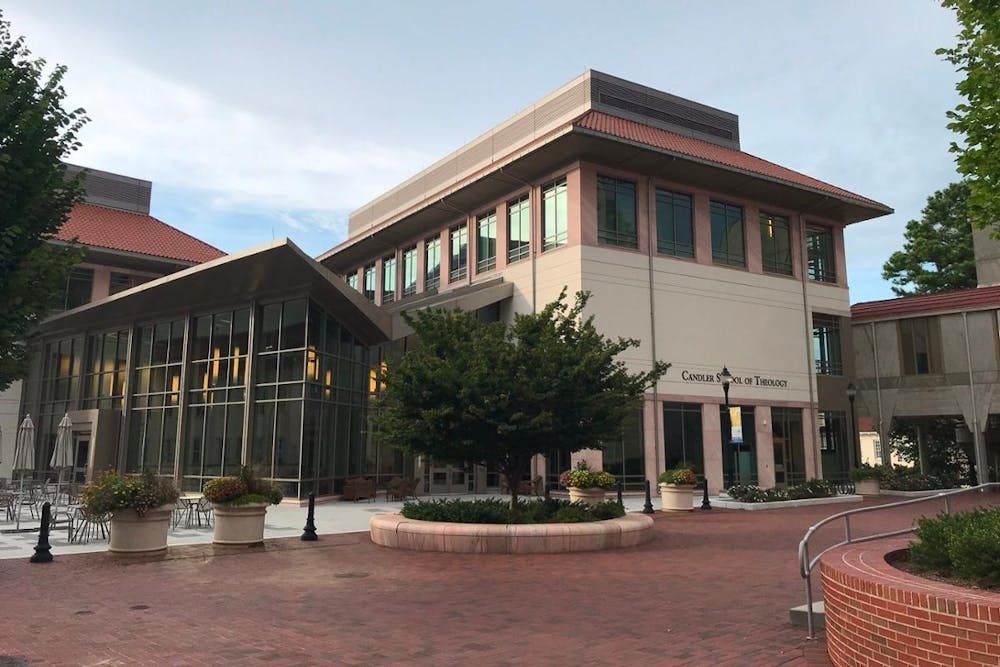
Stewart spoke as part of the Candler School of Theology’s conference titled “Pastoral Leadership in a Time of Christian Nationalism.”
At the beginning of her speech, Stewart highlighted how religious nationalism has evolved over time and has contributed to division in the United States.
“Religious nationalism is, in its extreme form, a kind of exclusionary nationalism on who gets to properly belong in a country and who doesn’t,” Stewart said. “In this most hard-line or extreme form, religious nationalism is an authoritarian’s best friend.”
Stewart also discussed her research on the intersection of religion and politics in the U.S., noting the influence of religion on the American youth and education system. She highlighted her experience with the Good News Club — an after-school program that aims to convert elementary-age children to a conservative form of Evangelical Christianity, according to Stewart. The Good News Club describes itself as an organization whose primary purpose is to “evangelize boys and girls with the Gospel of the Lord Jesus Christ.”
“They were telling kids attending the clubs that they needed to target their classmates,” Stewart said. “I could see that kids attending the clubs were singling out their non-Christian peers for conversion, but really for what I could only describe as faith-based bullying and bigotry.”
Additionally, Stewart stressed how authoritarian movements often latch onto legitimate social issues to redirect public anger toward perceived enemies. She said these movements deflect attention away from structural causes and toward scapegoats to reinforce their own power.
“The anti-democratic movement is very good at harnessing these grievances,” Stewart said. “The grievances, in many instances, are legitimate, but they harness those grievances and they create an enemy or scapegoat to blame and deflect attention from the real sources of their problems."
When asked about the future of the U.S. with the rise of Christian nationalism, Stewart emphasized that there is still hope for democracy, but she worries for the United States’ international reputation.
“It would take a lot to build back a reputation internationally,” Stewart said. “If you guys have been paying attention to where the dollar is going internationally, the dollar is at a low. It’s really awful, and I think that reflects a lot of the faith in American leadership.”
In an interview with The Emory Wheel, Assistant Dean of Methodist Studies Brett Opalinski (98T) said that he organized the event because of religious leadership in the current political climate.
“In such challenging political times, many folks serve in congregations that are very politically divided, or serve in communities that are very politically divided,” Opalinski said. “There’s a lot of deep questions about how do we exist in those spaces in meaningful, loving, kind and faithful ways. That’s what has inspired this whole Pastoral Leadership in a Time of Christian Nationalism conference to begin asking and looking deeply at some of those questions.”
Associate Professor of Methodist and Wesleyan Studies and Director of International Initiatives Geordan Hammond said that Stewart’s speech came at a relevant time.
“It’s one of the topics that our students are talking about a lot, an area of research that a number of our students are engaged in is Christian nationalism,” Hammond said. “Obviously, it’s a relevant topic to all of us right now.”
Candler Assistant Dean of Advancement and Alumni Engagement Bill Doerr reflected on Stewart’s speech, emphasizing how Christian nationalism affects everyone.
“Christian nationalism is something that we’re all experiencing in just the role of faith in government and politics,” Doerr said. “It was interesting to hear her feedback on just the way that Christian nationalism has been a real, significant organized movement with lots of money poured into the way that they have structured their work.”
Opalinski, who has previously served in churches with elements of Christian nationalism, highlighted the dangers of the emphasis on division within Christian nationalism.
“In some respects, many of our faith communities are microcosms for what’s happening in the larger world,” Opalinski said. “The dangers of an approach to faith and politics that divides, that creates an us versus them mentality, that seeks to name people as enemies and then silence their voices. It neglects the very tenets of our Christian faith and way of being.”


