
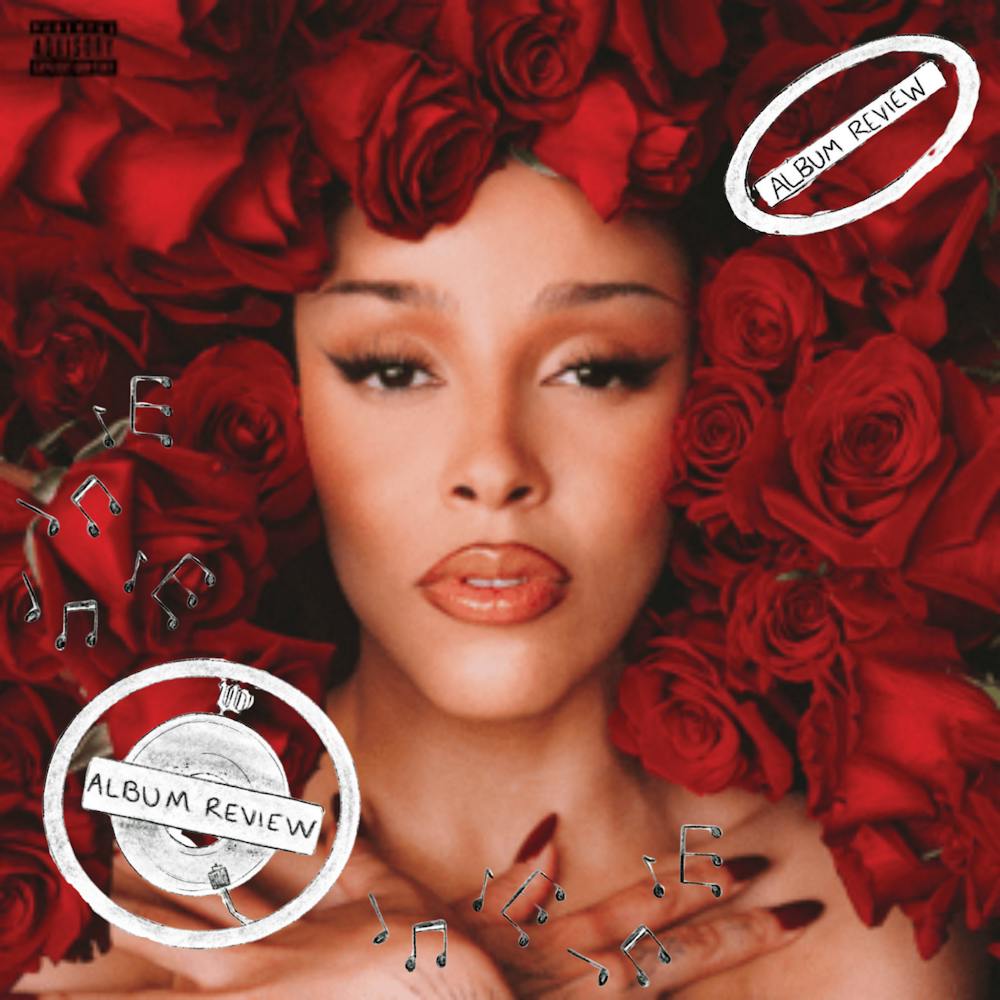
Doja Cat is not so much feline as reptilian — a musical chameleon that fits into no single box. After years of sonic transformations, from the glittering space-pop of “Planet Her” (2021) to the sexy menace of “Scarlet” (2023), Doja Cat switches from genre to genre, aesthetic to aesthetic, with an ease and flair that makes her one of this generation’s most intriguing and controversial superstars.
On Sept. 26, Doja Cat returned with “Vie,” her fifth studio album. Boasting a glamorous ’80s pop soundscape and smart, sexy lyrics, Doja Cat reinvents herself once again as she delves into love — how it forms, falls apart and returns with a searing vengeance.
The first track, “Cards,” introduces musical elements that reappear throughout the album: smooth jazz, groovy beats and witty wordplay. The song begins with a saxophone solo that melts into an alluring ’80s beat. Doja Cat enters in her distinctive high falsetto as she describes the push-and-pull of an unstable love, singing, “The more we can clear this smoke / A little further I’ll go.” Then, she tells her lover to “Play your cards (Right).” Doja Cat is in control — both a player and dealer in the love game.
Breaking into rap on the second verse, she watches her lover, waiting for him to prove himself and sporting a grin as he tries. “Might splurge in the yacht, I’m tryna figure out if he deserve it or not,” Doja Cat raps, laying down bars as she tries her hand at seduction. With layered vocals and a saxophone blaring under the beat, “Cards” marks Doja Cat’s entry into the lyrically dominating, sonically supple aesthetic of the rest of “Vie.”
“Jealous Type” arrives next, using the same saxophone-laden ’80s groove. Doja Cat layers her voice to perfection, flexing her vocal agility. She contemplates the choice between revenge or forgiveness, singing, “Could be torn between two roads that I just can’t decide / Which one is leading me to hell or paradise?” With an electronic beat that calls back to Imogen Heap’s 2005 song “Headlock,” Doja Cat slips between airy verses before returning to a comical and biting rap verse. “You don’t wanna show me off to your ex or your friends tonight,” Doja Cat raps, lamenting her partner’s cowardice while she slowly succumbs to the urge to start a fight. Her jealousy is dangerous, justified and wholly captivating.
Although “Vie” tackles serious subjects, Doja Cat remains playful even as she references love that might destroy her. “AAAHH MEN!” is a breathless, hilarious indictment of her lover. Above modulated trumpets that sound like the kickoff of a competitive medieval duel, Doja Cat comically condemns a childish man, rapping, “Why you always got a light ‘tude, lil’ brother?” However, she recognizes that her manchild debacle is a two-way street. “And if I had more common sense / Then I would grab my ride and dip,” Doja Cat sings, kicking herself but returning to her lover nonetheless. Doja Cat is funny, but not all her wisecrack lines land, such as when she suggests her partner come to church with her after his “goon sesh” — a line that is more wince-inducing than tongue-in-cheek.
On “Silly! Fun!” Doja Cat revels in unseriousness with eye-roll-worthy lyrics sprinkled through her expressive lines. Dominated by the same sarcastic flow that cemented her reputation as a lyrical comic in past songs like “Agora Hills” (2023), “Silly! Fun!” sits on the edge of a filler track. Doja Cat remains playful but does not try anything new or inspiring. She is strictly unserious, but her humor lands better on tracks like “AAAHH MEN!”
It is on the slower, more sultry tracks of “Vie” where Doja Cat shines. “Couples Therapy” begins with a gently oscillating synth before a heavy bass comes in to complement her soaring falsetto. “Leave me on read and fill my head with thoughts of dread / I feel so abandoned,” Doja Cat sings, revealing the weaknesses in her relationship while searching for a solution to her and her partner’s miscommunication. With a harp featured at the beginning and end of the track, alongside sensual synth production throughout, Doja Cat reveals the sweeter side of love while weaving in moments of emotional depth.
“Gorgeous,” another sensual track, lives up to its name. Amid a muted background and luxurious vocals, Doja Cat sarcastically explains the cost of beauty and fame, singing, “It’s a crime to be gorgeous / Between you and a million phones / They takin’ pictures like we hittin’ a pose.” Here, Doja toes the line between silly and serious. For an artist who regularly faces backlash over her wild sense of style, Doja Cat uses this track to highlight the cost of superstardom and its ramifications for her own self-image. She walks the line between self-confidence and insecurity, directing her professions of love not toward a man but toward herself.
Throughout the rest of the album, Doja Cat repeats much of the same — the ’80s beats, the verse-rap-verse structure and the love-ridden lyrics. From the trippy “Make it Up” to the gentle, joyous “Happy” to the smooth and seductive “Take Me Dancing (Ft. SZA),” Doja Cat settles into a soundscape that combines everything she is excellent at, including danceable production, funny rap verses and airy high-pitched vocals.
“Come Back” concludes the album, sparkling with chimes and glitzy production. She mourns a love that her partner ruined yet is still trying to repair, singing, “Beggin’ me, ‘Baby, come back to me’ (Come back).” She sticks up for herself, choosing dignity over a temporary comfort that will inevitably dissolve into another excruciating pain. She accepts moving on from a connection she severed, singing, “I can’t be your woman, but trust you’ll find someone (Come back).” Referencing the line “I can be your woman” from her 2021 hit song “Woman,” Doja Cat demonstrates emotional growth. The saxophone returns for one last solo before the song ends, marking a clear conclusion to the winding story of a chaotic relationship.
“Vie” tells a tale of love, loss, reconciliation and, sometimes, revenge. With audible consistency that verges on redundancy, “Vie” is cohesive if a bit overstuffed. Doja Cat continues to embody her eras, pushing its aesthetics to their limit. “Vie” has a clear theme and direction, boasting numerous moments that underscore exactly why Doja Cat remains a pioneer in genre blending. She offers an ’80s pop-rap record that leans into its strengths to the extreme.

Hunter Buchheit (he/him) (28B) is majoring in U.S. History and Business. He loves writing about music, Emory events and politics, and in his free time enjoys playing piano, running and spending hours crafting the perfect Spotify playlist.


