
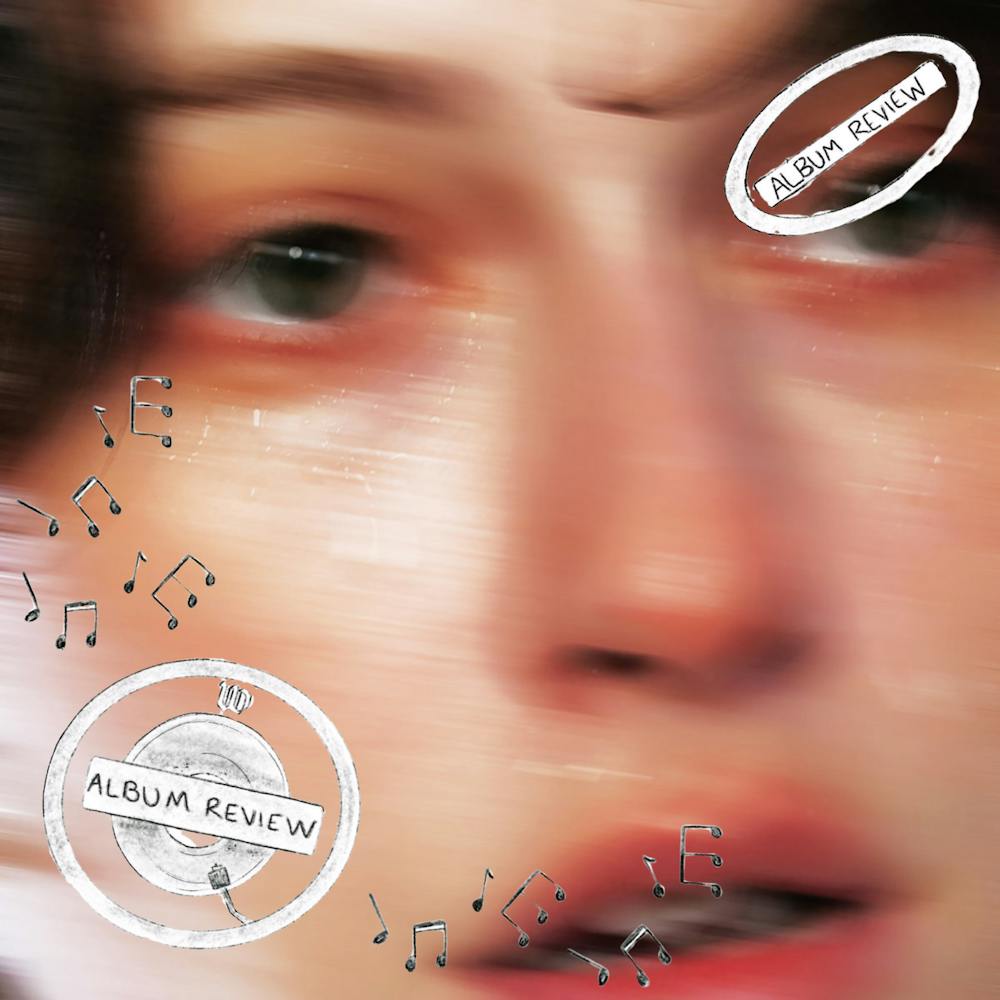
Mikaela Straus, the pop-rock musician known as King Princess, returns in royal form with her new project. Three years after the release of her sophomore album “Hold On Baby” (2022), Straus released her latest record, “Girl Violence,” on Sept. 12. Through a rowdy deluge of electric guitar, boisterous drums and swaggering singing, the 26-year-old continues to prove herself as one of today’s most dynamic and unpredictable musical acts.
The record begins with “Girl Violence,” a hushed, make-piece track that may not make much sense on first listen. The song comes to life with a powering sound as Straus’ voice fades in, drifting over a pool of synth waves. It is dark and cool, planting Straus on a rooftop staring into the city streets at night. Over a throbbing beat, she contemplates a newfound realization: “Why does nobody mention that girls can be violent?” Her voice — with its characteristic rasp and subtle indifference — desperately mulls over the ramifications of losing a partner: “And I guess it's true love / ‘Cause it truly f*cks with me,” she sings. As the rest of the record progresses, Straus does not shy away from this hurt. Instead, she finds herself running toward it and all its complicated manifestations.
“Origin” has a similar air of confusion to it. The subtle synths and Straus’ hushed vocals sound like the beginning of a Frank Ocean track but a little more disjointed. As she describes returning to her roots and reclaiming her power, Straus sings with a smirk, “I'm starting to feel myself again / Now I'm a f*cking sleeper.” Concluding with a recording of a child’s voice that is possibly her own, referencing the song’s nostalgic title, Straus makes up for the track’s lack of cohesion with ample musical breadth. She is unafraid to explore, tying together musical elements in unconventional ways and trying something new in this record. And while “Origin” may seem a bit misaligned, its strongest moments are the album’s best, as she weaves together spoken-word, quiet verses and an expansive soundscape in a way she never has before.
Of these forms, the heavy, hazy-eyed “I Feel Pretty” hits all the right notes. Above a mishmash of acoustic guitar and drums alongside buzzing synths that have the strength and urgency of a keyboard played right next to the listener’s ear, Straus experiments with perspective. As she melds together musical touches, she describes how her feelings while being with her partner are just as unpredictable: “She, she's playing with my time / She's playing with my life.” Straus’ lyrics, however, are not bitter but bittersweet. She most notices the way her partner makes her feel and the uniqueness with which her love strikes: “For the first time in years, I feel pretty / And she's trying her best to uplift me,” she sings.
On “I Feel Pretty,” Straus is vulnerable, channeling a downcast tone while laying out the story of how her partner is saving her from herself. The juxtaposition between the sadness she feels deep down and the joy her partner brings her is searing, emotional and gorgeous — like looking out into a desert as sunset falls. With a hard-hitting electric guitar breakdown, a whirlwind of emotions collapses.
On “Cry Cry Cry,” Straus flexes her rockstar capabilities. The track begins with a guitar solo that sounds like it was ripped from the start of a movie montage, leading into lyrics that put Straus’ bitterness on full display. She does not paint herself as a perfect person, and the messiness of her lyrics reflects her own messy emotions:“Ooh-ooh, you're gonna cry, cry, cry when you hear this,” she sings. With a bit of bitterness comes a little jealousy, framing a subtle sense of yearning that calls into question Straus’ insistence on breaking her ex’s heart.
“Say What You Will,” a collection of guitar, synth, autotune, harp and the confusing, almost-preach of Joe Talbot, whom this song features, would be refreshingly experimental if not for its length. It is too long to be an interlude but too short and disjointed to be a proper song. But between all of her musical experimentation, all of her raspy belts and hushed incantations, and all the emotion behind her no-holds-barred lyrics, like “Cut off any god that holds us skin-t0-skin,” her lyricism truly shines.
“Girls” is a career highlight for Straus. Beginning with a lazy, spinning synth — echoing the radio buzz that begins the record — the track falls into pace with a slow, swinging drum. Straus’ voice is layered and soulful, with a richness that comes through when she raises the stakes and ups the decibels. She sings about the power of her desire for girls and how they bring “violence” and “chaos” into her life, bringing her to her knees. She yearns for the kind of love that hurts her most, finding its draw irresistible despite the pain it brings her.
On “Girls,” she is tongue-in-cheek yet sincere. And with a boisterous chorus that has all the heartstring-tugging weight of Rihanna’s “Love on the Brain” (2016), Straus has never been more powerful. She channels the vocal depth of Amy Winehouse and the rasp of Miley Cyrus, sauntering through a seemingly simplistic song with her biggest display of exuberance to date. She signs off the track with a guttural and all-consuming electric guitar that reflects the all-encompassing ache of her desire.
Moving through the rest of the record, Straus touches on similar highs and stumbles over a few lows. “Covers,” an airy, lighter, almost-trippy track with a Radiohead-reminiscent beat, finds Straus as a ghost haunting her ex. As she sings about sticking around in her former lover’s mind, “And I suppose that I'm only a ghost / And you never want to see me in your room,” she flashes an occasional production trick, like a choppy, staticky effect mimicking that of a walkie-talkie on a ghost-hunting television show.
“RIP KP,” a brooding, bitter and lustful addition to Straus’ growing rock repertoire, is addicting in its heat, anger and sexiness — a complicated mixture that she has mastered. As an electric guitar chord shreds over a jamming bassline, Straus warns anyone interested in her partner: “My girl could destroy your life / Like she did to mine,” she sings. It is a dark, near-frenetic earworm, and it is precisely what Straus, with her all-out production, biting lyrics and strong vocals, does best.
“Girl Violence” concludes on a high note with “Serena.” The track is a sweet, almost melancholic meditation on how she hopes she could comfort someone that she loves: “If I could make you feel that you’re good,” she sings. It is a sentimental, rare heartfelt moment amid the album’s flurry of tension of every kind, from sexual to emotional. That range seems to be the point of her newest project. On “Girl Violence,” Straus pushes herself farther than she ever has before. She leans into experimentation, and she does not shy away from creating big moments to varying degrees of success. Most of all, we hear Straus uncover new strengths while she shows the risks she is willing to take for love.

Hunter Buchheit (he/him) (28B) is majoring in U.S. History and Business. He loves writing about music, Emory events and politics, and in his free time enjoys playing piano, running and spending hours crafting the perfect Spotify playlist.


