
In the back of Goodrich C. White Hall Room 208, Emory University Motion Picture and Digital Projectionist Saundra Conner tests the projector every Wednesday at 6 p.m., anticipating a trove of around 100 Emory and Atlanta community members to watch the latest installment of the University’s Cinematheque film series.
Every semester, the Emory Cinematheque draws community members to its free weekly screenings. Hosted by professors in the Department of Film and Media of Emory College of Arts and Sciences, the series features films on specific themes, by auteur directors and relevant to student coursework. Goodrich C. White Professor of Film and Media Matthew Bernstein elaborated on the difference between the Cinematheque and other focused screenings.
“It’s different from a film festival, which is a lot of screening concentrated over the course of a few days, but here’s your weekly appointment, 7:30 — White Hall 208,” Bernstein said.
Film and Psychology major Siena Lonsdorf (27C) is one of the students in the Cinematheque’s packed audience. She tries to attend a screening every week and enjoys basking in the Cinematheque’s purpose and atmosphere.
“It’s nice to have some place to go with your friends, and I would say community is one of the perks,” Lonsdorf said. “I also think that they show movies that you wouldn’t necessarily think of watching yourself. So, in that way, I think it’s really informative as someone who really likes film because you get to see what other people pick to show each semester.”
Behind the Cinematheque
In past years, the Cinematheque has screened films under a wide array of themes, ranging from the representations of African Americans in television, a series on Alfred Hitchcock and the French New Wave. Although the primary audience for the Cinematheque is Emory students, the film screenings regularly attract attendees from off campus.
“When we were doing the David Lynch series, I had somebody email me who drove in for a film from South Carolina,” Associate Professor of Film and Department Chair Michele Schreiber said. “We have a broad reach, and I think with the help of social media, we've been able to let people far and wide know what the programming is.”
All films are shown in White Hall 208, which boasts one of the largest academic classrooms on Emory’s campus. White Hall 208 is also where two 35mm and digital cinema projection (DCP) projectors reside.
The Cinematheque initially began as a series of film screenings, showing movies discussed in film classes on the big screen. Today, professors introduce and screen films relevant to their field of study. It was not until the late 1990s that the series became strictly semester-focused and adhering to one theme, which Bernstein noted as a “natural progression” towards the present-day series format.
“I arrived at Emory in 1989, and we were doing film series of various kinds,” Bernstein said. “We did a four-film series with the Japanese Consulate, and so we would show Japanese films and that was a lot of fun. So, we would do a couple of these across the year.”
Conner, who has been projecting films for three decades, recalled that Emory professors wanted to screen 35mm films but only had 16mm projectors in White Hall. The University contracted Cinevision Corporation in 1994 to help provide projection. This meant Cinevision set up the projectors, the University showed the film and then the company came back to campus the next day to take it apart. Ultimately, Emory allotted the department enough funding to purchase a 35mm/70mm projector with a platter from Cinevision.
Bernstein coincidentally found two 35mm projectors discarded at the Mall of Georgia in 2011 after Regal Theaters and all U.S. commercial movie theaters made the transition to DCP. He was able to connect with people working in the industry and eventually received two projectors for free, which the film department installed in White Hall Room 208.
Since the Cinematheque’s inception, the film department has grown fivefold. Schreiber said that when she first joined the faculty at Emory in 2008, the film department had four full-time faculty members. Now, the department boasts 20 members. The growth in size has allowed film faculty members to display a broader range of interests, translating to more diverse film series.
“Because we take turns doing the Cinematheque and we all come to the department with our different areas of research expertise, we’ve been able to expand what kinds of screenings we are offering through the Cinematheque,” Schreiber said.
Professors are given the liberty to screen whichever films they want, provided that they fit within the context of their academic focus and the prints are available. The Emory film department sources either 35mm prints or DCP films from various institutions, including Harvard University (Mass.), the Academy of Motion Picture Arts and Sciences and the Library of Congress.
Beyond the Cinematheque’s impressive coordination and logistics, the series also lets professors and students appreciate the simple feeling of watching films with their peers. Schreiber elaborated on this same sense of joy when she hosted a series on Alfred Hitchcock’s films with her students in 2018.
“To be able to show those films to an audience that was really excited about them and to introduce them, and for me to be able to watch them with an audience and to expose my students to those films, because it is such a different experience watching them with a crowd,” Schreiber said. “And even in our course screenings, it's wonderful to see them with other students.”
Rising senior Olivia Gilbert (26C) has been attending the Cinematheque since the first semester of her first year. Gilbert knew that she wanted to major in film and brought along a friend she met at first-year orientation to attend the Cinematheque. That year, Bernstein and the Cinematheque hosted a centennial tribute to Italian director and screenwriter Federico Fellini, and Gilbert and her best friend attended every screening.
“That just became a ritual for us, for the Fellini films,” Gilbert said. “We had never seen any Fellini films. We just went every single week to the point where we now know more about Fellini than we feel like anyone else does. And we were hooked after that.”
Conner emphasized that accessibility is one of the Cinematheque’s strengths compared to movie theaters like the Plaza Theatre and Tara Theatre in Atlanta.
“You go to a theater, you’re watching whatever is new,” Conner said. “But here at Emory, these are free movies. You’re already there doing schoolwork. You probably live right there [in] walking distance. ‘Hey, there’s this movie. I have never seen it before. I’ve heard it’s great. Let’s go see it.’”
Chomping into Fall 2025
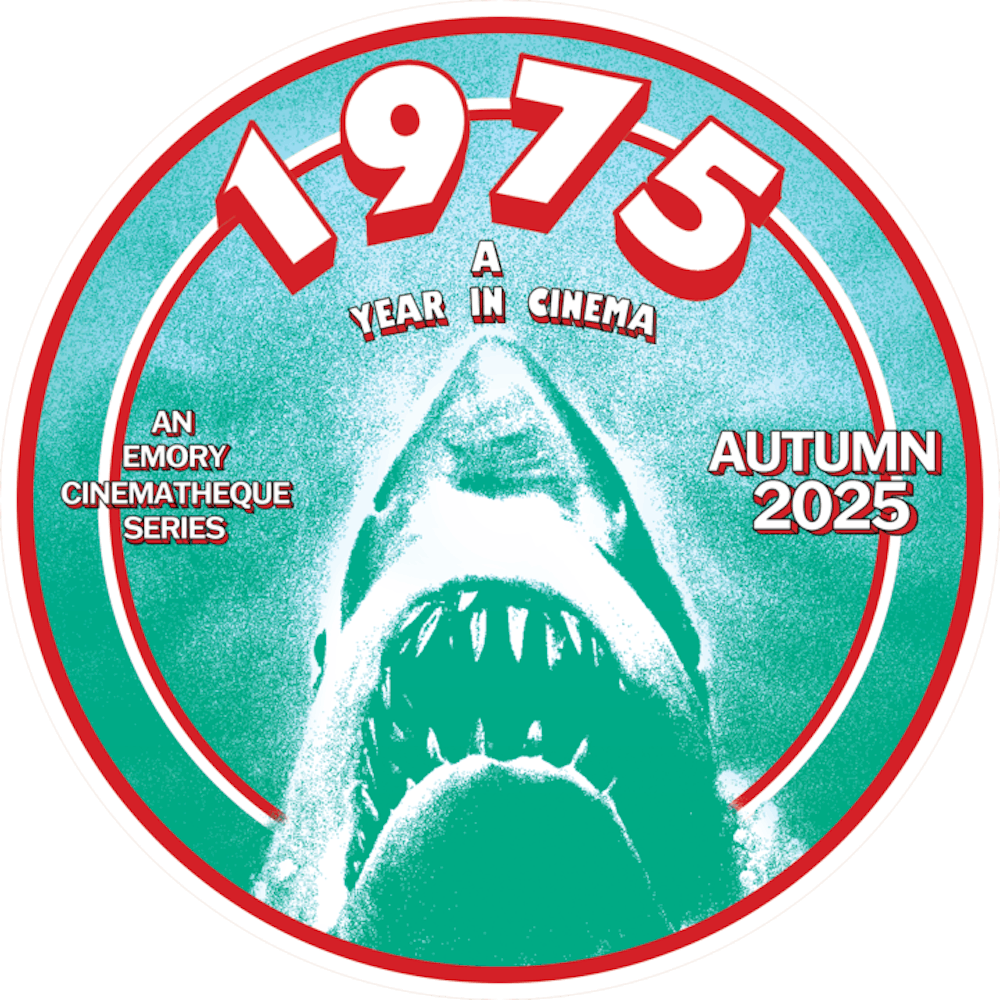
This fall semester, the Cinematheque will host a series of films directed in 1975. While the year was a box-office hit for Hollywood, featuring films such as Jaws (1975), One Flew Over the Cuckoo’s Nest (1975), Dog Day Afternoon (1975) and The Rocky Horror Picture Show (1975), the Cinematheque will project films from all over the world.
Associate Professor and Director of Undergraduate Studies Daniel Reynolds noted that the primary motivation for showing films made in 1975 is to mark their 50th anniversary.
“It just kind of occurred to me,” Reynolds said. “I was thinking about the fact that 1975 is a major transition year, especially for Hollywood cinema, and it’s the year that ‘Jaws’ came out. And ‘Jaws’ had this seismic effect on the way movies are made, promoted and released.”
Schreiber shared a similar sentiment and, in her opinion, believes that 1975 was a “pivotal” time in Hollywood film history because it marked a shift from the “classical Hollywood system” to the “tentpole blockbuster-driven film industry.”
“The ’70s was the bridge between what was before and what we are now,” Schreiber said. “Because the studio system was no longer in place, you started seeing filmmakers taking a lot more artistic risks with films.”
Normally, the Cinematheque assigns a faculty member to curate a list of films. However, this year, Associate Professor and Director of Undergraduate Film and Media Studies Daniel Reynolds pitched the idea of having different professors and faculty each present one film from 1975.
Reynolds noted that the selection of films was “verbal” at first. Eventually, he sent an email with a 1975 film list and asked whether any faculty members would be interested in presenting a film.
“Everyone could think of a film they loved from 1975,” Reynolds said. “It was also an opportunity for us to all come together as a faculty and work on this project together. And I think one that’s also an expression of film love that we can all think about movies that are important or that we like and that we want to present for the Cinematheque.”
Gilbert expressed excitement for the upcoming series.
“I’m looking forward to seeing what the lineup of films is going to be,” Gilbert said. “They always pick really, really great stuff.”
On Aug. 27, the Cinematheque will host its first segment of this semester's series with Nashville (1975). Shampoo (1975) and Barry Lyndon (1975) will follow on Sept. 3 and Sept. 10, with the rest occurring every Wednesday night.
One can perceive the Cinematheque as an escape for burnt-out students, idealistic first-year students, older couples or cinephiles alike who want to expand their movie tastes. The screenings in White Hall 208 at 7:30 p.m. draw them together, and after a professor introduces their film, the lights in the room begin to dim. Conner awaits her cue to begin projecting at 8 p.m. Audience members’ murmurs start to fade as the only source of light, the lens, projects an image onto the screen. For Bernstein, the Cinematheque is bigger than just watching a movie.
“I grew up in an era before home video, and so the theatrical experience, to me, has always been a defining aspect of cinema,” Bernstein said. “Seeing the film on a big screen, seeing the film with a group of people — it’s ephemeral. But for the duration of the film, you form a community.”

Clement Lee (he/him) (24Ox, 26B) is majoring in Business with area depths in Information Systems and Operations Management and Business Analytics. He is originally from Strasbourg, France, but now resides in Virginia Beach, Virginia. Outside the Wheel, Clement enjoys watching movies, running long distances and playing golf. You can find him leisurely reading Marcel Proust's, "In Search of Lost Time" on the Quad.


