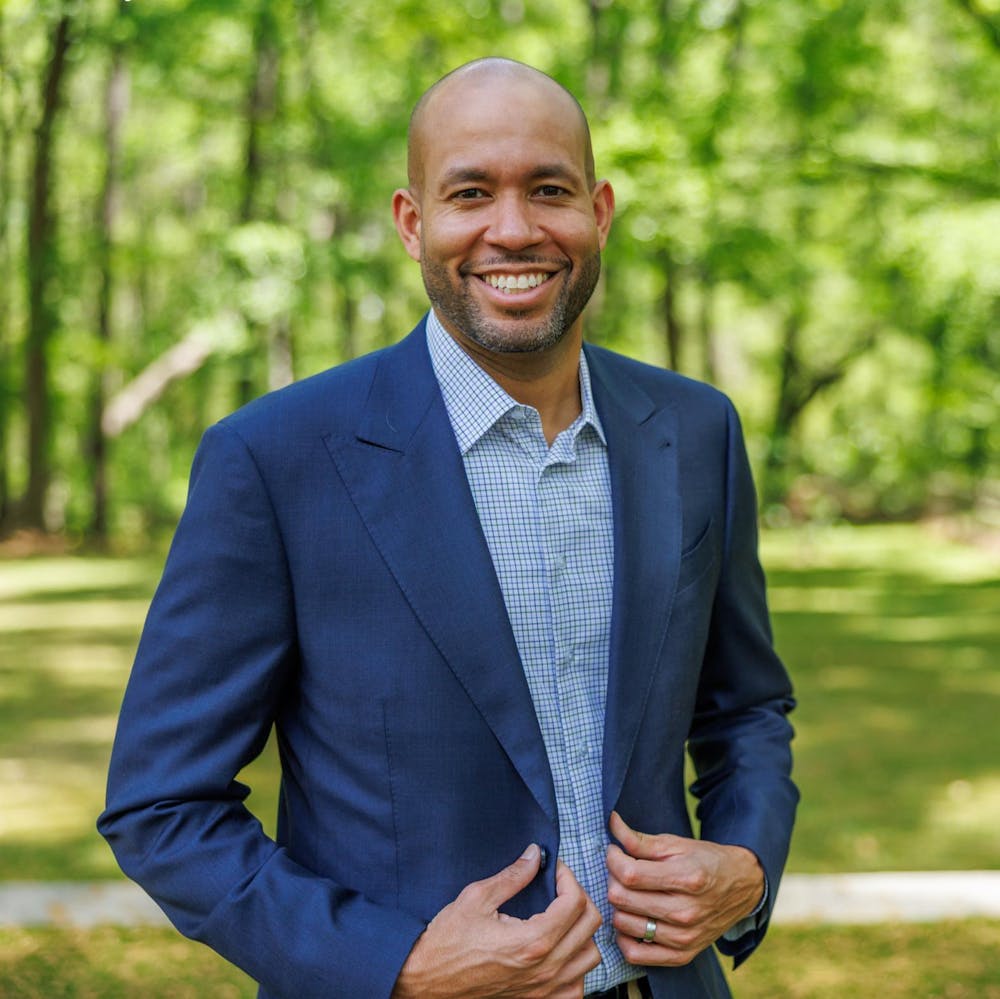
Before spending time in the Georgia State Senate, Jason Esteves (10L) roamed the halls of Emory University’s School of Law. Now, Esteves is aiming for the state’s highest office after announcing his campaign to become Georgia governor last year.
In an interview with The Emory Wheel, Esteves explained that his time at Emory played a formative role in shaping his approach to leadership and public service.
“It's at Emory Law where I really started to be involved in student organizations and student government,” Esteves said.
Standing in Esteves’ path to the November general election is a Democratic primary which includes, former Atlanta Mayor Keisha Lance Bottoms, former Lieutenant Governor Geoff Duncan and former DeKalb County CEO Michael Thurmond.
If elected, Esteves said he hopes to develop practical solutions to expand economic opportunity and strengthen Georgia’s public services, with his campaign prioritizing cutting the cost of living, expanding healthcare access and protecting reproductive freedom.
“My focus is on making sure that people can afford to live in the state,” Esteves said. “That we have a high-quality, accessible healthcare system and that our kids are getting the education that they deserve.”
Associate Professor of Political Science Andra Gillespie explained that reaching out to voters will be key for Esteves to stand out.
“You got to hit the doors,you got to introduce yourself to people, you got to tell people what you stand for, and you got to ask them to show up to vote for you,” Gillespie said. “He and any other of these candidates is going to have to make the case to the voters directly.”
Esteves said he hopes to reach voters by expanding his campaign beyond traditional party lines.
“If we stay laser focused on those kitchen table issues, issues that the people across the state talk about when they’re eating their meal with their family,” Esteves said. “We can build that coalition that it’s going to take to win, but it’s going to require me to stay focused.”
However, Gillespie emphasized that Esteves’ messaging alone cannot overcome Georgia’s Republican lean, having not voted had a Democrat serve as Governor since 2003.
“In really polarized environments, it really comes down to which side does the better job of getting their people to turn out to vote,” Gillespie said. “The national climate could help Democrats generally, but you still have to overcome the numerical disadvantage in the state.”
Masse-Martin NEH Professor of Political Science Zachary Peskowitz emphasized that even if Esteves secures the Democratic nomination, the general election in Georgia will be tough for Esteves.
“We’ve had Republicans win some statewide elections, Democrats win some statewide elections over the past few cycles,” Peskowitz said. “It’s really going to come down to perceptions of the Democratic and Republican nominees.”
Peskowitz also highlighted that a smaller portion of the electorate will ultimately decide the race, as midterm elections typically see fewer voters turnout. Another point Peskowitz makes is that the outcome of the race will likely hinge on a relatively small portion of undecided voters.
“There’s a good chunk of voters, maybe 10-20% of the electorate, that are going to be responding to things like the state of the economy and their perceptions of the policy positions and the competence and trustworthiness of the candidates,” Peskowitz said.
When discussing the election in relation to Emory students, Esteves highlighted the critical role voters play in shaping Georgia’s future.
“The main thing I want students to know is that their voice matters and that elections matter,” Esteves said. “The only way to influence elections is to use your voice, not only in the ballot box, but to also advocate for the positions that are most important for you.”
Esteves added that his campaign offers a positive future for all Georgians.
“I have a vision for the future of this state, one that ensures that no matter where you live in the state, you have the opportunity to thrive,” Esteves said. “That vision is one that gives people something to vote for, not just something to vote against.”